
BUSINESS
How Accounting Firms Help High Net Worth Individuals Protect Assets


You worked hard to build your wealth. Now you face lawsuits, taxes, and family conflict that can destroy it. High net worth brings comfort. It also brings exposure. You need a clear plan that shields what you own and supports the people you love. Accounting firms give you that plan. They track every dollar, reveal hidden weak spots, and design structures that keep assets out of reach from threats. In practice, that means smart entity choices, careful recordkeeping, and tax planning that does not cross legal lines. It means steady support when markets crash or laws change. If you use accounting in Northwest Iowa or across the country, the right team can coordinate with your attorney, banker, and advisor. Together they build a simple, strong defense around your wealth so you can protect your assets and focus on living.
Why High Net Worth Brings Higher Risk
Once your net worth grows, your name spreads. People know you have money. That attention draws lawsuits, business claims, and even pressure from relatives. It also brings close review from tax agencies.
Here are three common threats you face.
- Lawsuits from business partners, tenants, or customers
- Creditors after a failed deal or personal guarantee
- Family conflict over gifts, inheritances, or control
Each threat can reach your home, investments, and business shares if you leave them exposed. An accounting firm helps you see these risks before they explode.
How Accountants Build Asset Protection Walls
Accountants do more than file tax returns. They build money systems that separate, record, and protect. You get clear lines between your personal life and your business life.
Here are three core steps they use.
- Separate assets into different legal buckets
- Keep records that prove what belongs to each bucket
- Align tax moves with federal and state rules
The result is simple. You reduce what a lawsuit, creditor, or dispute can touch.
Using Entities To Shield Property
One key tool is the choice of entity. You might own rental houses, a family business, or a farm. If you hold all of it in your own name, one claim can hit everything. An accounting firm works with your attorney to place assets in entities that fit your goals.
Common structures include:
- Limited liability companies for rentals or side ventures
- Corporations for active businesses
- Family partnerships for shared investments
Each structure has different tax rules and protection rules. The Internal Revenue Service explains how these entities are taxed in the IRS business structures guide. An accountant reads those rules and shapes them around your situation. You gain protection without breaking the tax law.
Why Good Records Protect You In Court
Courts look at your records. If your books are sloppy, judges can treat your entities as fake. That move allows creditors to reach your personal accounts. An accounting firm keeps clean books that show real separation.
Strong recordkeeping does three things.
- Shows which entity owns each asset
- Tracks loans, gifts, and payments between family members
- Documents your tax choices with support
This proof can stop claims before they grow. It can also shorten audits and lower penalties if the IRS reviews your return.
Tax Planning That Reduces Exposure
High net worth means higher tax bills. It also means more chances to make mistakes that trigger audits. Accountants help you use legal tax rules that lower what you owe without crossing lines.
They look at:
- How gains and losses appear across your accounts
- How retirement plans fit your age and goals
- How gifts and inheritances affect estate tax
The IRS gives clear estate and gift tax rules at this estate and gift tax guide. Accountants use these rules to move assets to the next generation with less tax and less conflict.
Coordinating With Your Full Advisory Team
Asset protection works best when your team speaks often. Your accountant, attorney, banker, and investment advisor each see a piece. If they do not talk, gaps appear.
An accounting firm often serves as the hub. It sees every account and every transaction. It can:
- Flag when a business deal needs legal review
- Alert your banker before large moves
- Share tax impacts with your investment advisor
This steady contact keeps your plan current. It also lowers stress for you and your family.
Common Risks And Accounting Responses
| Risk | What Can Happen | How An Accounting Firm Responds
|
|---|---|---|
| Business lawsuit | Personal savings used to pay claims | Set up and track separate business entity records |
| Rental property accident | Other properties and accounts exposed | Place rentals in separate entities and keep clean books |
| Family dispute over money | Costly court battles and broken trust | Document gifts, loans, and ownership shares |
| Tax audit | Fines, interest, and stress for your family | Maintain support for every return and adjust plans to new rules |
| Sudden death or illness | Frozen accounts and confused heirs | Coordinate with estate attorney and map out asset transfers |
Protecting Your Family’s Future
Asset protection is not about hiding. It is about clarity, order, and fairness. You want your spouse, children, and causes to receive what you intend. You also want less fear during hard times.
A strong accounting partner helps you:
- See every asset on one clear list
- Match each asset with the right legal home
- Prepare your family for change and loss
You cannot control lawsuits, markets, or health. You can control how exposed your wealth remains. With the right accounting support, you place strong walls around what you built and give your family more peace.

Expanding across borders can feel like a risk. New tax rules, reporting demands, and cash questions hit you at once. You may hire translators and lawyers. You still need someone who understands numbers and rules in every country you enter. That is where an accounting firm becomes your quiet anchor. You gain a guide who tracks local tax laws, builds clean records, and spots danger before it grows. You also gain a partner who speaks with banks, investors, and regulators in clear terms. For a small company, that might start with an accountant in Homewood, IL. For a larger company, it can grow into a team on several continents. Either way, the right firm turns global growth from guesswork into a planned path. You focus on customers and products. They protect your money, your reports, and your peace.
Why global growth demands strict financial control
When you enter a new country, three money pressures hit fast.
- Local tax and payroll rules change how you pay workers and the government.
- Reporting rules change how you show profit, loss, and debt.
- Currency swings change what your cash is worth from one week to the next.
Each pressure can hurt your business. A missed tax rule can lead to fines. Weak records can block loans. Poor cash planning can force you to cut staff or close a branch. An accounting firm helps you keep control while you grow. You gain clear numbers for each country. You also gain a full picture of your whole company.
The U.S. Small Business Administration explains that sound records and controls reduce failure risk for growing firms.
How accounting firms guide you through global rules
Every country sets its own rules for taxes, payroll, and reports. You cannot copy and paste your home process. You need local insight that links back to your main books. Accounting firms fill that gap through three core services.
- Compliance. They read local tax codes, filing dates, and document needs. They keep you on time and in line.
- Reporting. They design reports that meet local rules and still fit your head office format.
- Controls. They help you set checks that keep fraud and waste from growing in new offices.
You also gain support for customs, import taxes, and cross-border billing. That support keeps your supply chain moving. It also keeps your prices honest and clear for buyers in each country.
What you gain from a global accounting partner
You may see accounting as record-keeping. Global work turns it into risk control. A strong firm helps you in three key ways.
- They protect you from legal trouble. Clean tax and payroll work cuts the chance of audits and fines.
- They protect your cash. Careful planning of costs, prices, and taxes in each country keeps your margins steady.
- They protect your time. Clear reports help you make fast choices on where to grow and where to slow down.
These gains matter for family-run shops and large groups. A small exporter that sells one product abroad still faces new tax and customs rules. A global chain that runs many plants faces even more. Each one needs a steady partner who understands global money rules and local habits.
Comparing in-house staff and external accounting firms
You may ask if you should grow your own staff instead of hiring a firm. Both paths can work. The match depends on your goals, risk comfort, and budget. The table below shows key tradeoffs.
| Factor | In house accounting team | External accounting firm
|
|---|---|---|
| Upfront cost | High. You hire and train full-time staff in each country. | Flexible. You pay for the scope of work you need. |
| Global tax knowledge | Often limited to a few countries. | Broader reach across many systems. |
| Scalability | Slow. Each new country needs new hires. | Faster. The firm adds or reduces support by contract. |
| Control over daily work | High. Staff sit inside your structure. | Shared. You set goals. The firm runs daily work. |
| Regulatory updates | Staff must track every change while doing daily tasks. | Firm assigns teams that watch legal and tax changes. |
| Risk if one person leaves | High. Loss of one expert can hurt a whole region. | Lower. The firm backs you with a team. |
Many growing companies use a mix. They keep a lean internal team that knows the business culture. They also hire an external firm for complex cross-border work.
How accounting firms support family-owned and smaller companies
Global growth is not only for large groups. Many family-owned firms now sell online to buyers in other countries. Others set up a small branch or warehouse abroad. Each step still needs clear records and tax work.
An accounting firm can help you.
- Choose the right business type in each country.
- Set up payroll and benefits that follow local law.
- Track inventory and sales across borders.
- Plan for income tax in both your home country and the new one.
The Internal Revenue Service explains how foreign income, withholding, and reporting work for U.S. persons and companies. An accounting firm uses rules like these to build clear plans for you.
Choosing the right accounting partner for global expansion
You should pick a firm with three traits.
- Proven cross-border experience. Ask which countries they support and how many clients they serve there.
- Clear communication. You need plain language on risk, cost, and choices.
- Strong controls. Ask how they protect your data and prevent fraud.
Then you can test the match with a small project. You might start with tax planning for one new country. You might ask for a review of your current records and controls. That first step shows you how they think and how they treat your staff.
Global growth brings pressure. It also brings a chance. With the right accounting firm beside you, you face new rules with calm and clarity. You gain numbers you can trust. You gain time to lead your people through change.
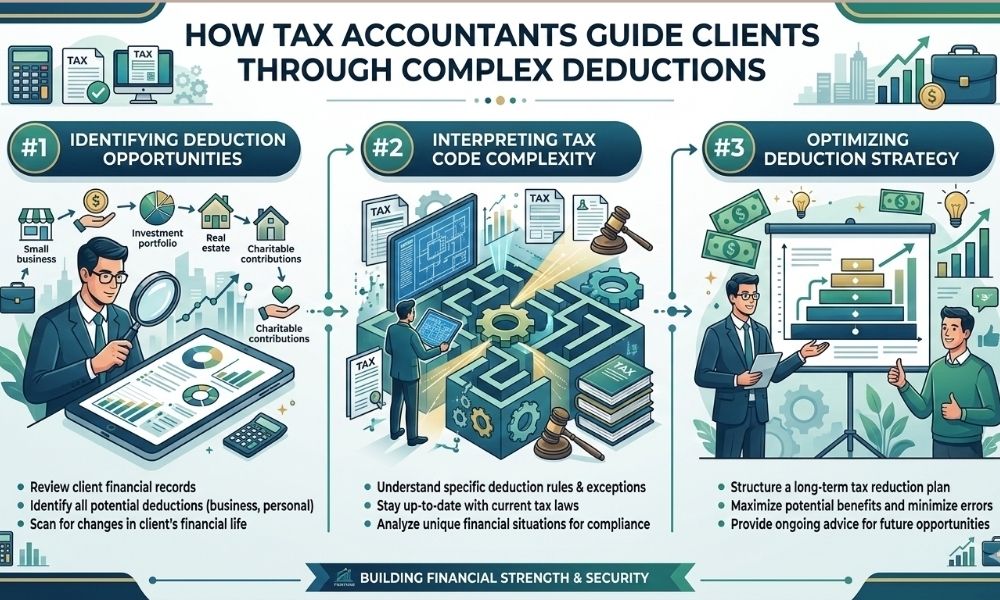
Tax rules can feel like a trap. One wrong choice and you lose money you need. Complex deductions create the most confusion. Medical costs, home offices, and business expenses each come with strict rules. Every line on a tax form can raise questions. A tax accountant helps you move through this pressure with a clear plan. You learn which records to keep, which receipts matter, and which numbers to leave out. You also see how one decision can change your refund or your tax bill. Through patient questions and direct answers, a tax accountant turns confusing rules into clear steps. This support is true whether you run a company, rent out a basement, or manage family bills. It is also true for people who work with accounting in West Seattle and for those who live far away. You do not have to face complex deductions alone.
Why Complex Deductions Feel So Overwhelming
Tax forms use short phrases that hide strict rules. You see words like “qualified,” “ordinary,” or “reasonable.” You guess at what they mean. The tax code uses exact meanings instead. A tax accountant knows those meanings. You get a clear yes or no instead of a guess.
Three things often cause the most strain:
- Unclear recordkeeping
- Mixed personal and business costs
- Fear of an IRS notice or audit
An accountant works through each of these with you. You do not have to carry the worry alone.
How Tax Accountants Turn Confusion Into Clear Steps
A good tax accountant does more than fill out forms. You get a process that repeats each year. That process usually follows three simple stages.
1. Understand Your Life, Not Just Your Numbers
The first step is a real talk about your life. You share how you earn money, how you spend it, and what changed this year. You may talk about:
- Job changes or side work
- Child care, college, or elder care costs
- Medical needs and insurance choices
- Home moves, home offices, or rental units
This talk helps your accountant spot deductions you might miss. It also keeps you from claiming ones you cannot support.
2. Sort Your Records Into Clear Groups
Next, you sort numbers into clear buckets. You learn which receipts and documents to keep together. Common groups include:
- Medical bills and insurance statements
- Mortgage interest and property tax records
- Charity letters
- Business or side gig costs
The IRS shares record tips in its guide on recordkeeping. You can read more at this IRS recordkeeping page. An accountant uses these same rules and shows you how to follow them with less stress.
3. Match Your Life To Specific Deductions
Once your records are set, your accountant matches them to tax rules. You see each deduction in plain terms. You learn:
- Who can claim it
- What counts and what does not
- What proof you should keep
Then you decide together which deductions to claim now and which to plan for next year.
Common Complex Deductions And How Accountants Help
Some deductions cause more anxiety than others. Here are three that often raise hard questions.
Medical And Dental Expenses
Medical costs can drain a family. The IRS allows you to deduct some costs that pass a set limit of your income. The challenge is knowing what counts. An accountant helps you sort:
- Doctor and hospital bills
- Prescription drugs
- Some travel for medical care
You can see the IRS rules in Publication 502 on medical and dental expenses. An accountant uses this guide and your records to see if itemizing makes sense for you.
Home Office Deduction
More people now work from home. Many wonder if they can claim a home office deduction. The rules are strict. The space must be used only for work and be your main place of business. An accountant:
- Reviews how you use the space
- Explains the “simplified” and “regular” methods
- Shows how the choice affects your tax and record needs
You gain clarity and avoid risky claims.
Business And Side Gig Expenses
If you run a small business or side gig, you face extra rules. You may mix personal and business spending. A tax accountant helps you draw a firm line. You learn how to track:
- Home internet and phone used for work
- Mileage for work travel
- Equipment and software
This protects you if the IRS asks questions later.
Standard Deduction Or Itemized Deductions
One of the first big choices each year is whether to take the standard deduction or itemize. This choice shapes every other step. An accountant compares both paths using your real numbers.
| Choice | What It Means | Good Fit When
|
|---|---|---|
| Standard deduction | Flat amount set by law. No need to list each cost. | You have a few deductible expenses. Your mortgage, medical, and charity costs are low. |
| Itemized deductions | You list each qualified cost, such as medical, taxes, and charity. | Your total deductible costs are higher than the standard deduction. |
| Mixed review | Your accountant tests both choices with your records. | Your totals are close. You want to see which path saves more. |
This clear comparison eases fear. You see the numbers, then choose the path that protects more of your income.
Planning With Your Accountant All Year
Tax work should not start in a rush each spring. You gain more when you stay in touch with your accountant during the year. Three moments matter most:
- Before you take on new work or a side gig
- Before you sell a home or rental
- Before you pay high medical or education costs
Each of these choices can change your tax bill. Early advice can turn a shock into a planned step.
Protecting Your Family And Your Peace Of Mind
Complex deductions are not a test of your worth. They are rules on paper. With the right guide, those rules stop feeling like a trap. A tax accountant helps you protect your income, support your family, and face tax season with less fear. You bring your story and your records. You leave with clear steps, honest answers, and more control over the money you work hard to earn.

Wealth can feel fragile. Markets change. Laws shift. One wrong move can erase years of effort. In this pressure, you need more than tax help. You need a steady partner who understands your money, your risks, and your goals. That is where skilled CPAs step in. They track every rule that touches your income, your property, and your estate. They spot quiet threats before they grow. They also help you keep more of what you earn, year after year. If you work with an Accounting firm in Santa Monica you gain a team that watches both numbers and human needs. They look at your family, your business, and your future plans. Then they build clear steps to protect what you built. This blog explains how CPAs become true partners in wealth preservation and why that partnership can mean the difference between short success and lasting security.
Why Wealth Preservation Needs More Than Investing
Wealth preservation is not only about stocks or property. It is about keeping what you earn when laws, health, and family needs keep changing. A CPA looks at three core questions.
- How much do you keep after tax each year
- What happens to your money if you die or become sick
- How secure is your income if work or business slows down
Each answer rests on clear rules. The tax code, estate rules, and business rules change often. The IRS lists new updates every year in its tax guidance. A CPA follows these shifts and adjusts your plan so your savings do not leak away through surprise bills or missed steps.
The CPA’s Role In Your Financial Life
You might think of a CPA as someone who files tax returns. That task is only one piece. A trusted CPA supports you across your life stages. Childhood, working years, and retirement.
- Early career. Set up smart saving habits and retirement accounts
- Family years. Plan for college, housing, and care for aging parents
- Business growth. Structure your company to protect income and limit risk
- Retirement. Manage withdrawals and required minimum distributions
- Legacy. Plan how money passes to children or charities
The U.S. Securities and Exchange Commission warns that emotional decisions often hurt long-term results. Their investor education pages explain how planning helps reduce fear and rushed moves. A CPA uses that same steady mindset. You gain a calm voice when markets fall or when a big life event hits.
Key Ways CPAs Protect Your Wealth
A good CPA uses clear methods to guard your money. Three stand out.
1. Strategic Tax Planning
Taxes are often your highest yearly cost. Careful planning can free money for saving or giving. A CPA can help you
- Choose the right filing status
- Use credits for children, education, or energy upgrades
- Place investments in the right accounts
- Plan stock sales to manage gains
- Time big gifts or donations
Each step reduces waste. You keep more without cutting back on your life.
2. Risk Management And Protection
Wealth can drain from lawsuits, illness, or failed deals. A CPA reviews your whole picture. Income, property, debts, and business exposure. Then the CPA works with your attorney and insurance agent. Together they help you
- Use the right business structure
- Track and separate personal and business costs
- Review coverage for health, life, and disability
- Plan for care needs in old age
This team approach protects you from shocks that can wipe out savings.
3. Estate And Legacy Planning Support
Many people avoid talking about death or disability. The result is confusion, family conflict, and large tax bills. A CPA helps you face these topics with clear facts. You can
- List all accounts and property
- Plan who will receive what and when
- Reduce possible estate taxes
- Set up a plan for children or family members with special needs
This process gives your family clarity and peace. It also keeps courts and taxes from taking control.
CPA Support For Families And Small Business Owners
Families and small business owners often carry the most strain. You may feel pulled between saving for your children and keeping a business alive. A CPA can help you
- Build a simple budget that respects your values
- Track cash flow for your home and business
- Set pay for yourself that is fair and safe
- Plan for a business sale or handoff to family
This support gives you room to care for children, parents, and workers without losing your own future.
How CPAs Compare To Other Financial Helpers
| Partner Type | Main Focus | Key Strength | Common Limits
|
|---|---|---|---|
| CPA | Taxes, reporting, and long-term planning | Deep knowledge of tax law and record keeping | May not manage investments directly |
| Financial Planner | Saving and investing plans | Helps set and track money goals | May not focus on detailed tax rules |
| Attorney | Legal rights and documents | Drafts wills, trusts, and contracts | May not review yearly money habits |
| Insurance Agent | Risk coverage | Understands policy choices | Focuses on products, not full money picture |
The strongest results come when your CPA works with these partners. Each brings a piece. Your CPA helps connect the pieces into one clear plan.
Choosing A CPA As A Long-Term Partner
You trust a CPA with private details about your income, debts, and fears. You deserve someone who earns that trust. When you meet a CPA, ask
- What experience do you have with people like me
- How do you charge for your work
- How often will we talk each year
- Do you coordinate with my planner and attorney
Notice how the CPA explains things. You should feel heard and respected. You also should leave with clear steps, not confusion.
Turning Uncertainty Into A Clear Plan
Money fear can feel heavy. You may worry about job loss, illness, or how your children will cope after you are gone. You do not need to carry that alone. A CPA can help you face hard facts, accept limits, and use the rules to your benefit.
First, gather your records. Second, talk openly about your hopes and fears. Third, follow through on the plan you built together. With that partnership, wealth preservation becomes less about luck and more about steady, honest choices that protect the people you love.

Why Accounting Firms Are Essential Partners for Global Expansion

5 Ways Orthodontic Services Improve Confidence In Young Patients

The Role Of Preventive Dentistry In Supporting A Brighter Smile

Linda Susan Agar: A Visionary Leader Shaping the Future of the Technology Industry 2024

Make1M.com Luxury Watches: Timeless Elegance Meets Financial Freedom

eCrypto1.com Crypto Wallets: The Ultimate Guide to Secure and Efficient Cryptocurrency Storage 2025
-
 CELEBRITY1 year ago
Linda Susan Agar: A Visionary Leader Shaping the Future of the Technology Industry 2024
-
 FASHION1 year ago
Make1M.com Luxury Watches: Timeless Elegance Meets Financial Freedom
-
 CRYPTO1 year ago
eCrypto1.com Crypto Wallets: The Ultimate Guide to Secure and Efficient Cryptocurrency Storage 2025
-

 CELEBRITY1 year ago
The Life and Legacy of Harlow Andrus: A Journey of Heritage and Inspiration 2024
-

 CELEBRITY1 year ago
The Viral “Emiru Handbra” Moment: How It Became a Stunning Social Media Sensation in 2024
-

 FASHION1 year ago
McKinzie Valdez: Journey from Social Media Star to Entrepreneur 2024
-

 CELEBRITY1 year ago
Matt Danzeisen: The Quiet Yet Powerful Figure Behind Peter Thiel’s Success 2024
-

 CELEBRITY1 year ago
Deja Jackson, Ice Cube’s daughter, basketball career, biography 2024